
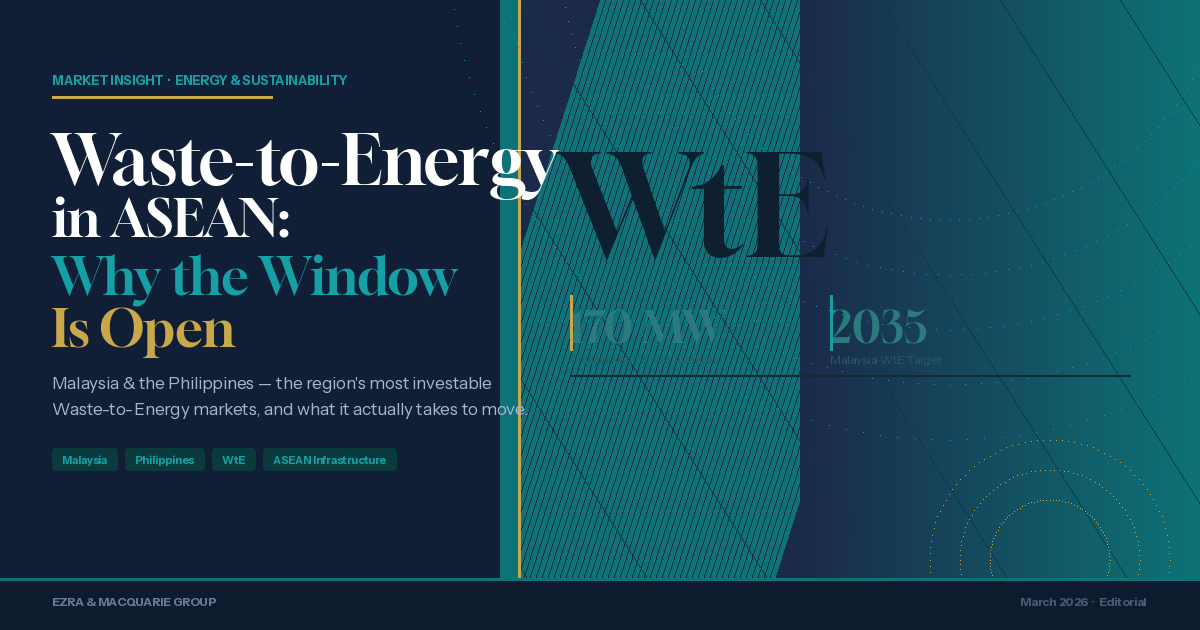
Waste-to-Energy in ASEAN: Why the Window Is Open — and Why Malaysia and the Philippines Must Act Now
We provide a strategic perspective on Southeast Asia’s emerging waste-to-energy sector, focusing on Malaysia and the Philippines. This article distills key policy and investment trends, emphasizing the importance of proactive, locally informed engagement to unlock value in this evolving landscape.
INSIGHTS
Ezra & Macquarie | Editorial
3/2/20268 min read
Southeast Asia is sitting on one of the most promising infrastructure investment opportunities of this decade — and it is hiding in plain sight, inside its own landfills.
The region generates hundreds of millions of tonnes of municipal solid waste every year. Urban populations are growing. Landfill capacity is nearing its limits. And governments across ASEAN are under growing pressure to demonstrate credible progress on energy transition commitments made at COP28 and beyond.
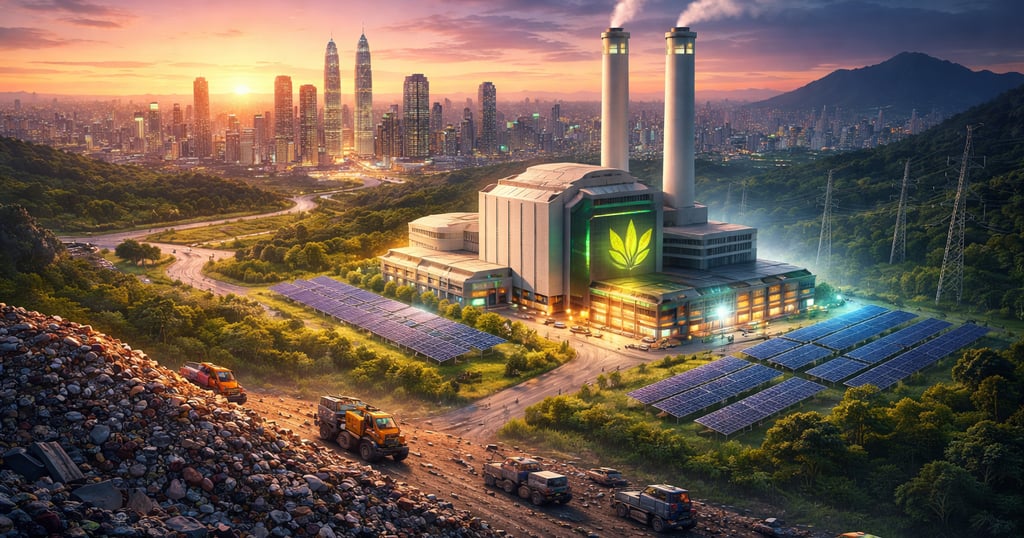
Waste-to-Energy (WtE) — the conversion of non-recyclable municipal solid waste into electricity or heat through thermal combustion and related technologies — addresses both challenges simultaneously. It decreases landfill dependency, cuts methane emissions from decomposing waste, and contributes baseload renewable power to stressed grids.
The technology is proven. The capital is available. The policy direction is clear.
What has slowed deployment is not ambition — it is regulatory readiness and project structuring. In most ASEAN markets, WtE has been treated as an aspiration rather than a priority for delivery. But that is changing, and changing quickly. The governments that move decisively in the next two to three years will define the infrastructure landscape for the next two decades. Those who do not will find themselves locked out of an investment cycle that will not wait.
Among ASEAN markets, two stand out as the most immediate and investable opportunities: Malaysia and the Philippines.
Malaysia: Strong Policy, Execution Gap
Malaysia has set out one of the more coherent energy transition frameworks in the region. The National Energy Transition Roadmap (NETR), launched in 2023, targets 31% renewable energy generation by 2025, rising to 40% by 2035 and 70% by 2050. WtE sits explicitly within this framework, alongside solar, hydro, and bioenergy.
On solid waste, the policy intent is equally clear. The Housing and Local Government Ministry has outlined plans for WtE facilities across all states by 2035. The NETR specifically flags co-funding for WtE development, landfill taxes, and quota mechanisms as tools to accelerate the transition away from open landfills. Malaysia’s Twelfth Malaysia Plan targets a household recycling rate of 40% — a target that simultaneously creates the sorted feedstock base that improves WtE economics.
Tax incentives are already in place. The Green Investment Tax Allowance (GITA) and Green Income Tax Exemption (GITE) — enhanced in the 2024 budget and available for qualifying green activities through 2026 — reduce the cost of capital for WtE developers and their equity partners.
The fundamentals are sound: a growing urban population, declining landfill capacity, rising waste volumes, and a government that has explicitly prioritised this sector in its transition planning.
So where is the gap?
The challenge in Malaysia is execution, not intent. WtE procurement remains fragmented across state governments. Unlike solar, which has benefited from a structured national auction mechanism (the Large Scale Solar programme), WtE has no equivalent — projects are negotiated bilaterally, leading to inconsistent terms, longer timelines, and higher transaction costs for investors. This structural divide between policy commitment and bankable project delivery is what has prevented the pipeline from materialising at scale.
Private developers and infrastructure investors looking at Malaysia need to work around this fragmentation. That means investing early in stakeholder mapping across state and federal agencies, recognising that regulatory clearance paths differ significantly by state, and structuring projects with sufficient flexibility to absorb approval delays.
The opportunity is real. The execution environment requires a partner who understands how the system actually works, not just how the policy documents say it should.
The Philippines: Regulation Has Arrived — The Race Is On
If Malaysia’s WtE story is about bridging the policy-to-execution gap, the Philippines’ story is about a window that has just opened and will not stay open indefinitely.
For years, the Philippines’ WtE sector was constrained by a fundamental legal ambiguity. The Ecological Solid Waste Management Act (RA 9003) placed heavy emphasis on waste minimisation, while the Renewable Energy Act promoted WtE technologies — creating conflicting signals that stalled project development and deterred investment.
That ambiguity is now being resolved at pace.
In late 2025, the Department of Energy (DOE) issued Department Circular No. DC 2025-11-0026, establishing a formal framework for integrating WtE facilities into the national power generation mix. This was followed almost immediately by the announcement of a special Green Energy Auction (GEA-6) dedicated exclusively to WtE projects — the first of its kind in the country’s history.
The numbers are significant. Metro Manila and highly urbanised cities (HUCs) across the Philippines generate an estimated 6.12 million metric tons of municipal solid waste annually — equivalent to approximately 335 MW of baseload generation capacity. The initial auction targets 170 MW: 120 MW from Metro Manila, with the remaining capacity split across Bacolod, Cebu, Cagayan de Oro, and Davao. A follow-up auction for biomass and WtE projects across the wider country is planned for Q2 2026.
Pioneer WtE projects achieving commercial operations by March 2028 are eligible for significant incentives: exemption from the competitive selection process, priority dispatch on the wholesale electricity spot market, assured feedstock supply agreements with local government units, and access to incentive schemes under either the Renewable Energy Act or the CREATE MORE Act.
The Energy Regulatory Commission has set an initial ceiling tariff of P8.0167 per kWh for the auction — a rate that, combined with the tipping fee revenue stream and available incentives, can support viable project economics for well-structured developments.
This is a genuinely time-sensitive opportunity. The pioneer designation — and the incentives attached to it — is specifically designed for projects that move now. Developers who spend the next 12 months waiting for further regulatory clarity will find themselves competing in subsequent auction rounds without the benefit of pioneer status, against a more crowded field and potentially under less favourable terms.
The structural challenge in the Philippines differs from that in Malaysia. The core risk is not regulatory ambiguity — that is now substantially resolved at the national level. The challenge is the decentralised nature of waste management governance. Under Philippine constitutional law, solid waste collection and disposal services are the remit of local government units (LGUs). Securing feedstock supply agreements with LGUs is therefore a critical project development task, and one that requires careful political mapping and long-term relationship management at the city and municipal level — not just engagement with the national DOE.
The Bottleneck Is Not Capital or Technology
It is worth being direct about what is holding back WtE deployment in both markets — because the answer is the same in both cases, and it is not what most investors initially assume.
The technology works. Incineration systems with EU-equivalent emission standards are proven across European and East Asian markets. Project finance structures for WtE are well understood. Capital is available, from both development finance institutions and private infrastructure funds actively seeking ASEAN exposure.
The bottleneck is project structuring and regulatory navigation.
In both Malaysia and the Philippines, the gap between a WtE project that looks good on paper and one that actually reaches financial close comes down to three things:
1. Policy-to-finance translation. Regulatory frameworks in both markets are designed by governments with public interest objectives — not to be immediately legible to infrastructure investors. Bridging this gap requires active work to translate policy intent into bankable project structures with realistic timelines, risk allocations, and exit scenarios.
2. Multi-stakeholder alignment. WtE projects sit at the intersection of energy policy, waste management regulation, environmental compliance, and local government authority. In the Philippines, this means the national DOE, DENR, LGUs, and the ERC. In Malaysia, it means federal ministries, state governments, and JPSPN (the Department of National Solid Waste Management). Projects that fail to secure alignment across all of these stakeholders — and that get sequenced wrongly — routinely stall or collapse.
3. Local execution capability. The difference between a project that moves and one that does not often comes down to who is on the ground, navigating the regulatory process in real time. International capital without local execution capability is consistently outcompeted in ASEAN infrastructure markets.
These are solvable problems. But they require the right partners — those who understand both the technical requirements and the institutional landscape.
The Infrastructure Cycle Will Not Wait
ASEAN’s WtE infrastructure cycle has a timing dimension that investors and government stakeholders alike need to take seriously.
The economics of WtE project development mean that the plants being designed and structured today will be delivering power in the late 2020s and operating for 20 to 25 years thereafter. The regulatory frameworks being put in place now — in the Philippines especially — are specifically designed to accelerate the first wave of projects. That first wave will establish the template: the tariff benchmarks, the feedstock agreement structures, the permitting precedents. Subsequent waves will be built on that foundation.
Governments that move decisively in this window will have operational WtE capacity coming online as their landfills reach capacity and their energy transition commitments intensify. Governments that delay will find themselves managing a dual crisis — overflowing waste infrastructure and a renewable energy shortfall — simultaneously.
For investors and developers, the logic is similar. The pioneer incentives in the Philippines are time-limited. Malaysia’s policy framework is in place, but the absence of a structured national procurement mechanism means early movers who build relationships and secure sites now will be better positioned when that mechanism emerges. The cost of waiting is asymmetric: the upside of moving early is significant, the downside of moving late is substantial.
Ezra & Macquarie’s Position
Through our ongoing partnerships, Ezra & Macquarie is actively engaged in bringing proven EU-standard WtE incineration technology to Malaysia and the Philippines. We cover project structuring, financing, infrastructure development, land sourcing, logistics, and project management.
We are not observing this market from the outside. We are working within it, which is where the real constraints and opportunities become visible.
For governments, municipalities, and investors seeking to understand the WtE landscape in these two markets, we are available to discuss the specifics — including project feasibility, regulatory pathways, technology selection, and partnership structures.
The window is open. The question is who moves through it.
Ezra & Macquarie Group is a strategic advisory and technical solutions firm working across energy, infrastructure, and sustainability throughout Southeast Asia. For enquiries related to waste-to-energy project development in Malaysia, the Philippines, or the wider ASEAN region, contact us at contact_us@ezra-macquarie.com.
Notes & Sources
Malaysian Investment Development Authority (MIDA). National Energy Transition Roadmap (NETR): Charting a Path to a Sustainable Energy Landscape. January 2024. https://www.mida.gov.my/national-energy-transition-roadmap-netr-charting-a-path-to-a-sustainable-energy-landscape/
U.S. International Trade Administration. Malaysia Waste Management. https://www.trade.gov/market-intelligence/malaysia-waste-management
Government of Malaysia. National Energy Transition Roadmap, Part 2. 2023. Solid waste management policy section. https://www.christopherleeong.com/wp-content/uploads/2024/09/230903-National-Energy-Transition-Roadmap-Part-2.pdf
MIDA. Waste to Energy for a Sustainable Future. https://www.mida.gov.my/waste-to-energy-for-a-sustainable-future/
MIDA. National Energy Transition Roadmap (NETR). January 2024. (GITA/GITE section.) https://www.mida.gov.my/national-energy-transition-roadmap-netr-charting-a-path-to-a-sustainable-energy-landscape/
Deen, N.A. et al. From Waste to Renewable Energy: A Policy Review on Waste-to-Energy in the Philippines. Sustainability, MDPI. August 2023. https://www.mdpi.com/2071-1050/15/17/12963
Layug, J.M. Garbage out, garbage in: Philippine waste-to-energy projects. Law.Asia. January 2026. https://law.asia/philippine-waste-energy-wte-projects-doe-auction-2026/
Philippine Information Agency. DOE to Launch Special Green Energy Auction (GEA) on Waste-to-Energy (WTE). October 2025. https://pia.gov.ph/press-release/doe-to-launch-special-green-energy-auction-gea-on-waste-to-energy-wte/
Philippine Information Agency. DOE to Launch Special Green Energy Auction (GEA) on Waste-to-Energy (WTE). October 2025. https://pia.gov.ph/press-release/doe-to-launch-special-green-energy-auction-gea-on-waste-to-energy-wte/
Philstar. DOE targets 170 MW for waste-to-energy auction. November 2025. https://www.philstar.com/business/2025/11/09/2485761/doe-targets-170-mw-waste-energy-auction
BusinessWorld. Pioneer incentives eyed for waste-to-energy projects. October 2025. https://www.bworldonline.com/economy/2025/10/19/706546/pioneer-incentives-eyed-for-waste-to-energy-projects/
BusinessWorld. Pioneer incentives eyed for waste-to-energy projects. October 2025. https://www.bworldonline.com/economy/2025/10/19/706546/pioneer-incentives-eyed-for-waste-to-energy-projects/
Philstar. ERC proposes P8/kWh cap for WTE auction. January 2026. https://www.philstar.com/business/2026/01/19/2501865/erc-proposes-p8kwh-cap-wte-auction
Layug, J.M. Garbage out, garbage in: Philippine waste-to-energy projects. Law.Asia. January 2026. https://law.asia/philippine-waste-energy-wte-projects-doe-auction-2026/
Sumaria, M. G. C., & Sumaria, R. (2025). Waste Electrical and Electronic Equipment (WEEE) management and policy frameworks in the Philippines: A mini review. Annals of Tropical Research/Annals of Tropical Research (Visayas State University-Online). https://doi.org/10.32945/atr4712.2025
© 2008 – 2026 Ezra & Macquarie Group. All rights reserved. Powered by Britannia Ventures.
A strategic advisory and technical solutions firm helping governments, corporations and investors across Asia shape strategy, de-risk execution and deliver measurable impact.

Our Services
Infrastructure & Industrial Solutions
Brand & Market Positioning
Capability Building & People
Company