
Southeast Asia in an Unstable World: A Region Holding Its Ground
As geopolitical tensions reshape global trade, energy, and supply chains, Southeast Asia is holding its ground. Ezra & Macquarie shares its perspective on what is unfolding across the region — and why we remain firmly committed to building here for the long term.
INSIGHTSREGIONAL OUTLOOKTHOUGHT LEADERSHIPGEOPOLITICS
Ezra & Macquarie | Editorial
3/9/20265 min read
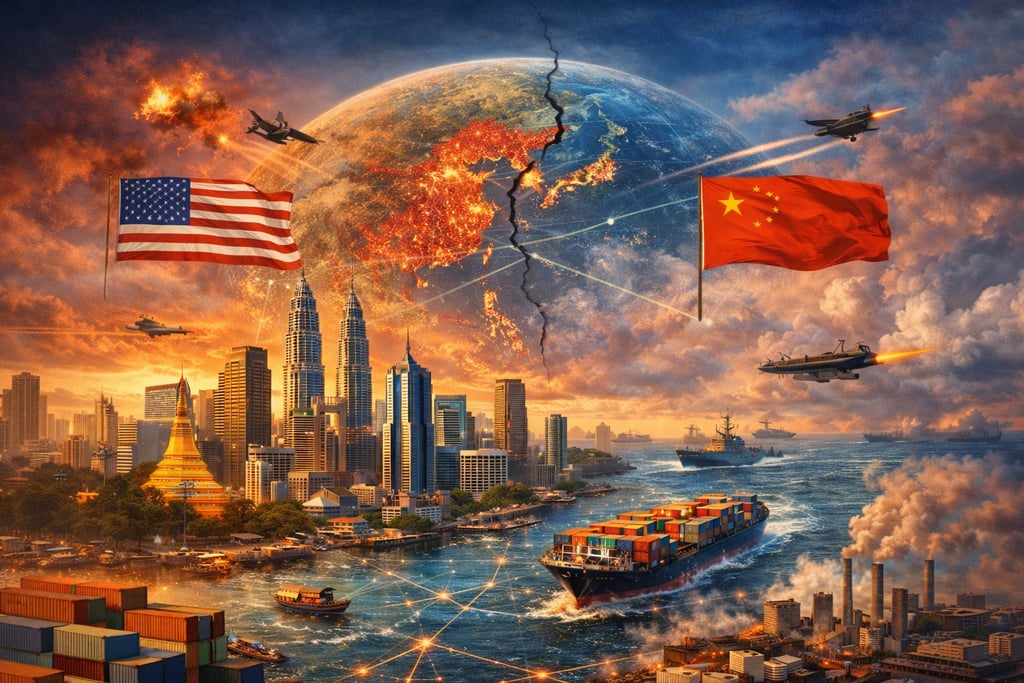

The world in 2026 is defined by uncertainty. Trade routes are contested, supply chains are being redrawn, and the competition between major powers is altering economies and industries at a pace that few anticipated. Yet in the midst of this turbulence, Southeast Asia stands out — not as a region immune to the pressures, but as one that, by and large, navigates them with a degree of pragmatism and steadfastness that the rest of the world would do well to notice.
At Ezra & Macquarie, with our office established in Malaysia and our work spanning engineering, safety, and technical advisory across the region, we are watching these shifts closely. This is our perspective on what is unfolding — and why we remain firmly committed to Southeast Asia.
A World Being Restructured
The global order is under significant strain. US-China rivalry continues to drive the political and strategic-level dynamics of the Asia-Pacific, with neither Washington nor Beijing in uncontested primacy Thediplomaticinsight — a state of affairs that analysts have described as "G2 flux." The consequences are not abstract. Trade flows are being redirected, investment decisions are being considered through a geopolitical lens, and industries that once operated on the assumption of a stable, rules-based global order are having to rethink their assumptions.
Add to this the continuing conflict in Ukraine, tensions in the Middle East, and localised flashpoints across Southeast Asia itself — including the fragile situation in Myanmar and recently renewed border tensions between Thailand and Cambodia — and the picture becomes one of a world in genuine structural transition.
For firms operating regionally, this is not background noise. It is the operating environment.
Southeast Asia: The Pragmatic Middle
What makes Southeast Asia distinctive in this context is its studied refusal to be pulled entirely into either camp. Southeast Asian countries have adapted to great power rivalry by harmonising their strong economic ties with China alongside their defence partnerships with the US and its allies Gsdn — a balancing act that is neither easy nor guaranteed to hold, but which has thus far served the region well.
ASEAN enters 2026 facing a more demanding regional and global environment, with external pressure from intensifying major power competition coinciding with persistent internal frictions that test its cohesion and policy bandwidth. Seapublicpolicy And yet, the bloc continues to function as a meaningful anchor — enabling dialogue, managing disputes through diplomacy, and projecting enough collective weight to remain relevant to all sides.
For international businesses and investors, this positioning is significant. Southeast Asia is not a passive bystander in the geopolitical contest — it is an active, if careful, participant. And that agency creates opportunity.
Energy Security: The Defining Challenge
Perhaps nowhere is the relationship between geopolitics and regional development more visible than in energy. Southeast Asia's energy demand is projected to increase 2.6 times its 2022 levels by 2050, and approximately 82% of this rising demand is still expected to be met by fossil fuels ASEAN Centre for Energy — a dependency that creates both strategic risk and real urgency around the transition to increasingly resilient and diversified energy systems.
Energy security is no longer simply about generation capacity — it is about technological access, trade resilience, and strategic arrangement. Caseforsea The US-China contest over clean energy supply chains has made this painfully clear. The US imposed tariffs of up to 3,521% on solar panel imports from Southeast Asia because of concerns about Chinese subsidies Caseforsea, and major battery investment projects in the region have been suspended as a result — showing just how quickly external political decisions are able to disrupt regional energy plans.
ASEAN's vision for a connected energy future faces intensifying challenges, including grid stability pressures as renewables scale, climate impacts on assets, and global supply chain interruptions for critical components. Adb These are not problems that can be solved by any single country alone — they require the kind of regional coordination and public-private collaboration that ASEAN is, slowly but meaningfully, beginning to build.
Supply Chains: Disruption as the New Normal
The restructuring of international supply chains is creating both risk and opportunity for Southeast Asia. The region has become a primary destination as businesses diversify beyond China-dependent nodes Hushvault, with manufacturing, logistics, and technology investment flowing into Vietnam, Malaysia, Indonesia, Thailand, and the Philippines in growing volumes.
ASEAN is preparing to launch its 2026–2030 ASEAN Economic Community Strategic Plan, striving to deepen integration while tackling digital transformation, supply-chain security, and uneven development. Thesoutheastasiadesk If delivered effectively, this system could meaningfully strengthen the region's position as a reliable, integrated production and trade hub — exactly what global businesses are seeking to reduce single-point dependencies.
Malaysia, in particular, is favourably placed. Geopolitical disputes driving the US-China technological race have opened opportunities for markets, including Malaysia and Singapore, to position themselves as non-aligned and embed themselves in crucial supply chains. Asia House. This is not a coincidence — it reflects years of investment in infrastructure, education, and institutional capacity that are now paying dividends in a world that suddenly values diversification above all else.
Where Ezra & Macquarie Stands
We are not geopolitical analysts. But we are a business operating in this region, with a presence in Malaysia and a portfolio of work that touches energy, safety, infrastructure, and technical advisory — all sectors that sit directly in the path of these shifts.
Our view is this: Southeast Asia's moment is real, but it is not guaranteed. The region's ability to capitalise on the opportunities created by global restructuring depends on the depth of its institutions, the quality of its infrastructure, and the willingness of its private sector to engage seriously with the challenges, not just the upside.
That is why we invest in the region. That is why we engage with regulators and industry bodies. And that is why we continue to build the kind of long-term presence that reflects genuine conviction, not opportunism.
The world is unstable. Southeast Asia is not immune. But it is, in our view, one of the most attractive places in the world to be building something right now.
References
The Diplomatic Insight — 10 Things to Watch in Southeast Asia in 2026 — https://thediplomaticinsight.com/10-things-to-watch-in-southeast-asia-in-2026/
GSDN — Geopolitical Outlook for Asia in 2026 — https://gsdn.live/geopolitical-outlook-for-asia-in-2026/
Southeast Asia Public Policy Institute — Southeast Asia Global Relations Outlook 2026 — https://seapublicpolicy.org/southeast-asia-global-relations-outlook-2026-part-1-10-things-to-focus-in-2026/
CSIS Indonesia / ASEAN Energy — Energy Security in Transition: ASEAN's Path to Strategic Resilience — https://www.aseanenergy.org/opinion/energy-security-in-transition-aseans-path-to-strategic-resilience
CASE for Southeast Asia — Southeast Asia's Energy Transition is Walking a Tightrope — https://caseforsea.org/southeast-asias-energy-transition-is-walking-a-tightrope/
Asian Development Bank / SEADS — Securing an Energy-Resilient Future for ASEAN — https://seads.adb.org/news/securing-energy-resilient-future-asean
The Southeast Asia Desk — Southeast Asia 2026: Between Fracture, Transition, and Reinvention — https://www.thesoutheastasiadesk.com/p/southeast-asia-2026-between-fracture
HushVault — Southeast Asia 2026: Navigating US-China Competition, Supply Chain Fragmentation & Strategic Risk — https://www.hushvault.ie/2026/01/23/southeast-asias-rising-strategic-weight-enterprise-risk-in-a-contested-region/
Asia House — Asia House Annual Outlook 2026 — https://www.asiahouse.org/research-insights-publications/annual-outlook-2026/


© 2008 – 2026 Ezra & Macquarie Group. All rights reserved. Powered by Britannia Ventures.
A strategic advisory and technical solutions firm helping governments, corporations and investors across Asia shape strategy, de-risk execution and deliver measurable impact.

Our Services
Company